Here's where you can learn a little Ontario history
Thomas "Carbide" Willson 1860-1915
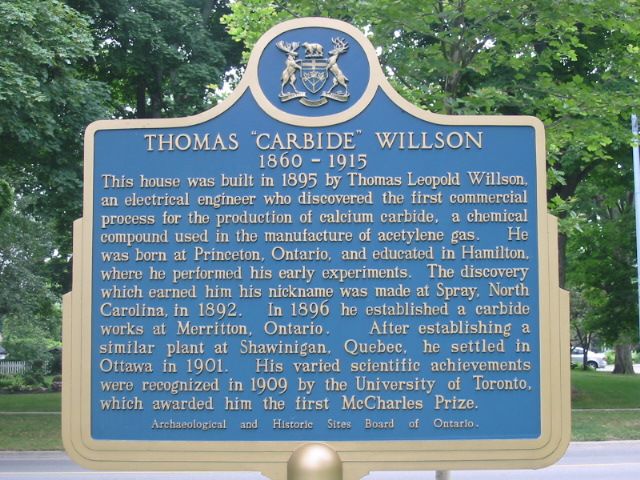
Photo by Alan L Brown - August, 2004
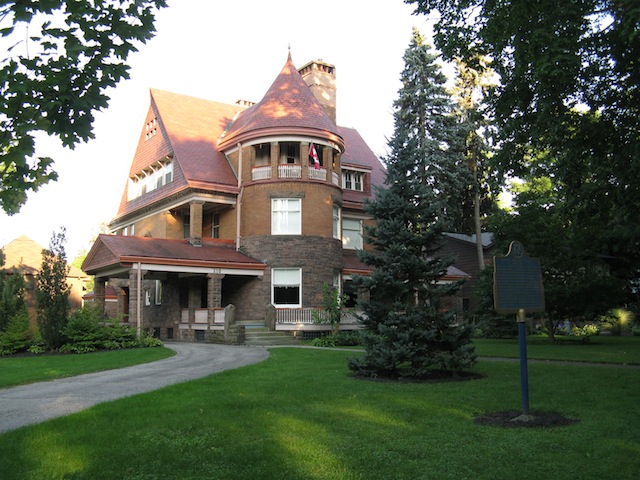
Photo by contributor Wayne Adam - October, 2010
Plaque Location
The County of Oxford
The City of Woodstock
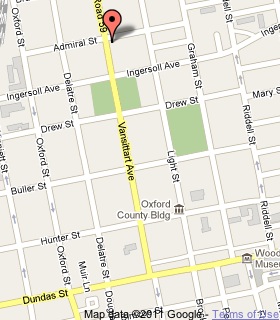
On the southeast corner of Vansittart Avenue and Admiral Street
Coordinates: N 43 08.200 W 80 45.829 |
 |
Plaque Text
This house was built in 1895 by Thomas Leopold Willson, an electrical engineer who discovered the first commercial process for the production of calcium carbide, a chemical compound used in the manufacture of acetylene gas. He was born at Princeton, Ontario, and educated in Hamilton, where he performed his early experiments. The discovery which earned him his nickname was made at Spray, North Carolina in 1892. In 1896 he established a carbide works at Merritton, Ontario. After establishing a similar plant at Shawinigan, Quebec, he settled in Ottawa in 1901. His varied scientific achievements were recognized in 1909 by the University of Toronto, which awarded him the first McCharles Prize.
More
Entrepreneurs
Here are the comments for this page.
(none yet)
Here's where you can write a comment for this page.
Note: If you wish to ask me a question, please use the email link in the menu.
Note: Comments are moderated. Yours will appear on this page within 24 hours
(usually much sooner).