Ontario's Historical Plaques

at ontarioplaques.com

Learn a little Ontario history as told through its plaques

Arctic Watershed

and

The Arctic Watershed


There are two plaques about this watershed on this page.
The first is in the District of Timiskaming.
The second is in the District of Thunder Bay.

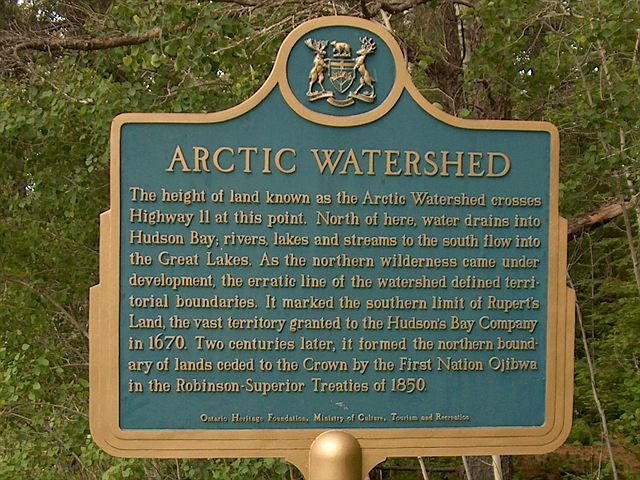
Arctic Watershed

Photo by contributor Jamie Toeppner - Posted November, 2005

Arctic Watershed

Photo from Google Street View ©2010 Google - Posted October, 2010

Plaque Location

The District of Timiskaming
On Highway 11, where the watershed crosses the highway
15.5 km north of Highway 66


Coordinates: N 48 13.047 W 80 15.413

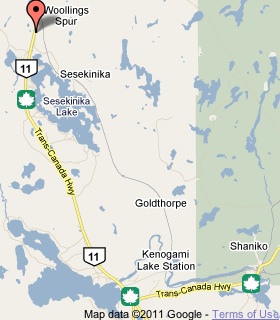
Map

Plaque Text

The height of land known as the Arctic Watershed crosses Highway 11 at this point. North of here, water drains into Hudson Bay; rivers, lakes and streams to the south flow into the Great Lakes. As the northern wilderness came under development, the erratic line of the watershed defined territorial boundaries. It marked the southern limit of Rupert's Land, the vast territory granted to the Hudson's Bay Company in 1670. Two centuries later, it formed the northern boundary of lands ceded to the Crown by the First Nation Ojibwa in the Robinson-Superior Treaties of 1850.


The Arctic Watershed

Photo by contributor Anonymous - Posted November, 2005

The Arctic Watershed

Photo from Google Street View ©2010 Google - Posted October, 2010

Plaque Location

The District of Thunder Bay
The Township of Golding
On Highway 17, about 23 km west of
the Highway 11/17 split west of Thunder Bay


Coordinates: N 48 49.099 W 89 55.177

Map

Plaque Text

North of this watershed all flowing water eventually reaches Hudson Bay, while south of it all watercourses form part of the Great Lakes drainage system. The height of land follows an erratic course of some 2250 km across Ontario, ranging from 32 to 280 km north of Lakes Huron and Superior. This watershed was declared the inland boundary of the tract surrendered to the Crown by Ojibwa Indians in the Robinson Superior Treaties of 1850. It was also widely considered to be the southern limit of Rupert's Land, the vast, ill-defined Hudson's Bay Company territory transferred to Canada in 1870, and it figured prominently in the Ontario-Manitoba boundary dispute of 1883-4.


Related Ontario plaques
The Robinson Superior Treaty
Ontario Boundary Dispute

More
Information

More
Lakes and Rivers


Here are the visitors' comments for this page.

Posted December 27, 2011
The Arctic-Atlantic watershed boundary's eastern terminus is Cape Chidley; more precisely Killiniq Island, shared by Labrador and Nunavut, where, as with the Labrador-Quebec border, the political boundary follows the hydrographic one. Immediately beside the island is a point where Nunavut, Quebec, and Newfoundland and Labrador meet at a 'triple point'. The Laurentian Divide's western end is in Montana, but that divide separates Arctic from Atlantic waters, and is not the end of the Arctic watershed boundary. That continues north up the Rockies along the Great Divide, marking the division between Arctic and Pacific waters, ending in northwest Alaska's Lisburne Peninsula.
-Wayne

Posted December 25, 2011
Thank you for posting images of these plaques.

Posted February 15, 2011
The Laurentian Divide, separating the Arctic Ocean/Hudson Bay drainage basin from those of the Gulf of Mexico and the Great Lakes, is a fascinating geologic feature. Its western end is at aptly-named Triple Divide Peak in Glacier Nat'l. Park, Montana (where it meets the "East-West" Continental Divide). Its eastern portion forms the boundary between Labrador and Quebec.

Here's where you can write a comment for this page.

Note: If you wish to ask me a question, please use the email link in the menu.

Note: Comments are moderated. Yours will appear on this page within 24 hours
(usually much sooner).